Parts Bin is a database of the electronic parts I have on hand. I connected it to GPT through MCP so we can check those parts while we design a circuit together.
While I was designing the button for Rocky, my smart speaker, I needed to figure out how far its plunger should reach. GPT checked Parts Bin on its own and found a tactile switch assortment I’d bought.
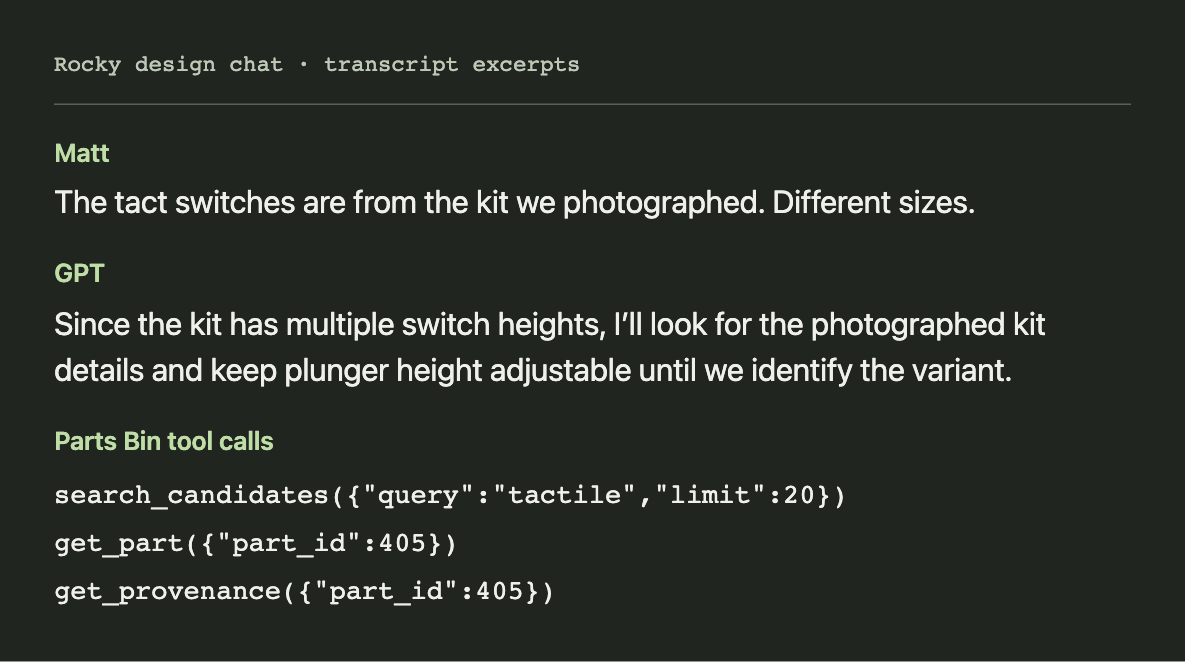
Excerpt from the Rocky chat: I mentioned the kit we photographed. GPT searched Parts Bin for “tactile,” then opened record 405 and checked its provenance.
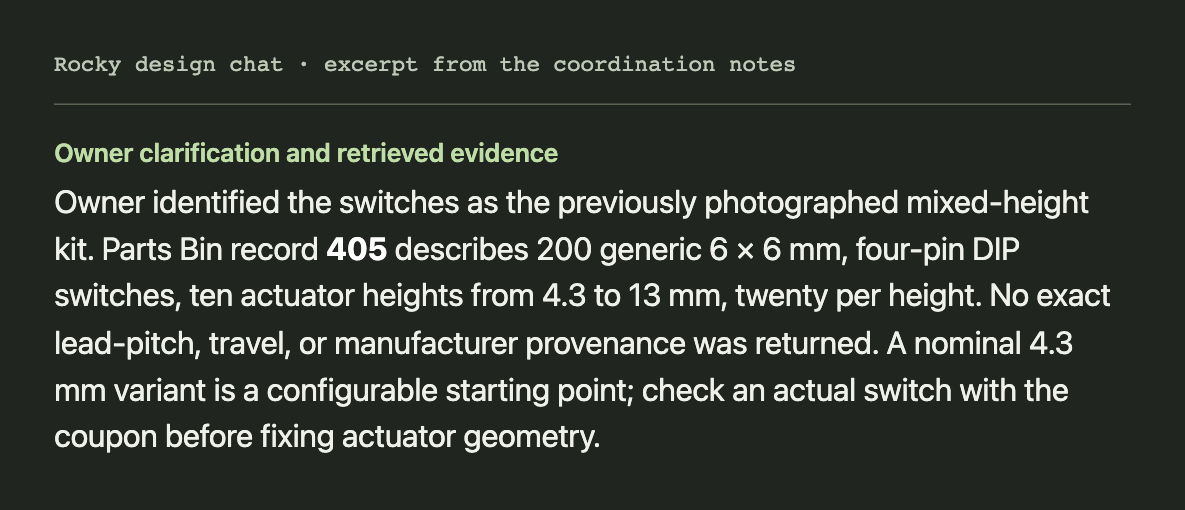
All ten sizes had the same 6 × 6 mm footprint. The shortest switch was 4.3 mm tall, so we used that as the starting point for the plunger. The next step was a small test print to see how the button felt with that switch underneath it.
The coordination note GPT wrote during the chat records ten heights from 4.3 to 13 mm and calls for checking the switch travel with a test print.
That’s why I connected my inventory to GPT through MCP. We were talking about a button, and GPT could look up the parts I actually owned right there in the design conversation.
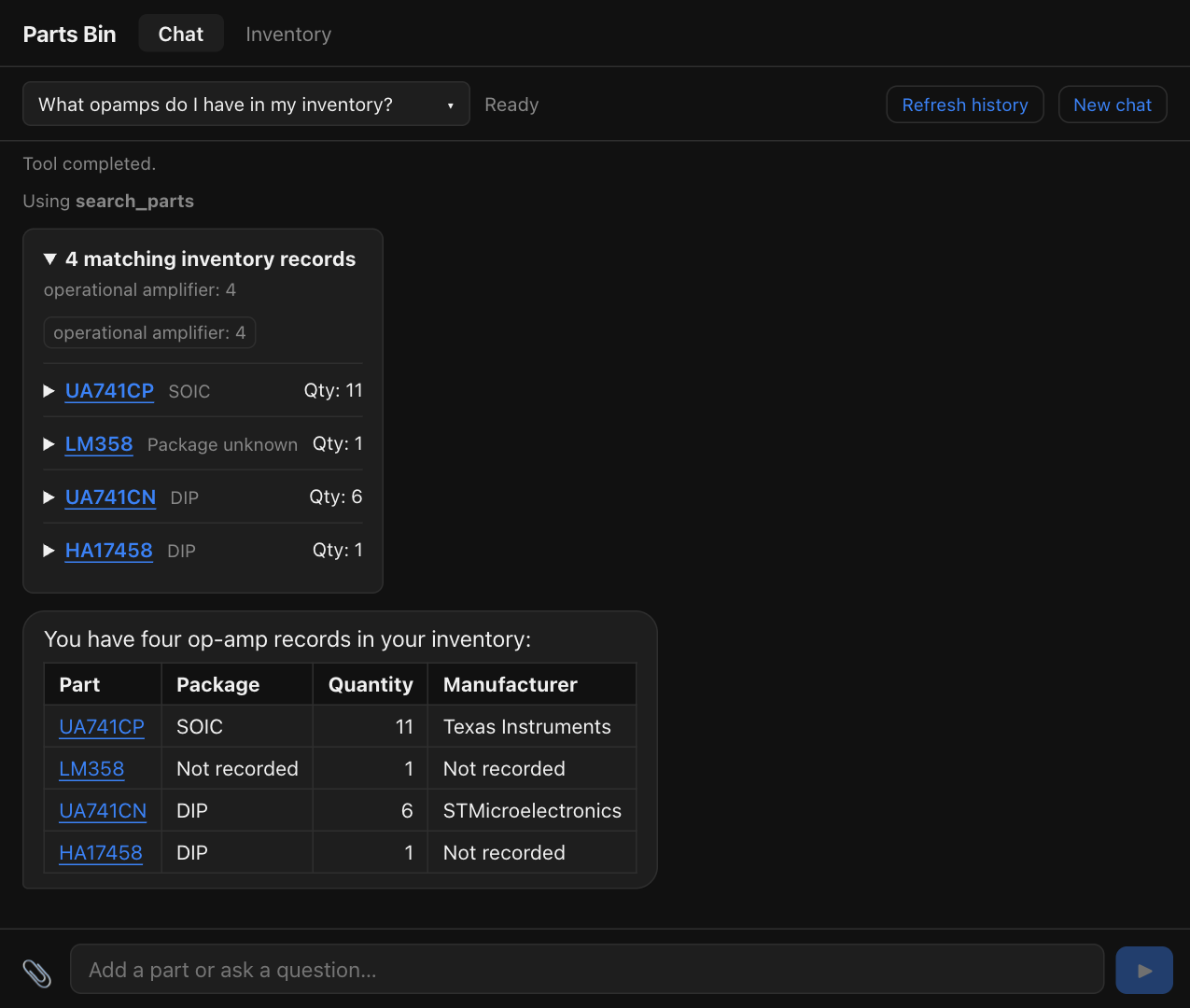
I also use Parts Bin on its own. I like picking up component assortments on AliExpress, and sometimes all I remember is buying a bag of op-amps. I can ask “What opamps do I have in my inventory?” and get the part numbers, packages and quantities.
A Parts Bin chat answering my op-amp question. The table includes one LM358 and six UA741CN chips in DIP packages.
When I’m putting a circuit together, I want to know what I already have. The parts list might call for a resistor, a capacitor, and an op-amp, all tucked away in different drawers.
Sometimes all I have to go on is the marking on a package. Other times I know the description, or I have a photo to help identify the part. Those all lead back to the same stock records, which I keep in PostgreSQL on my own server.
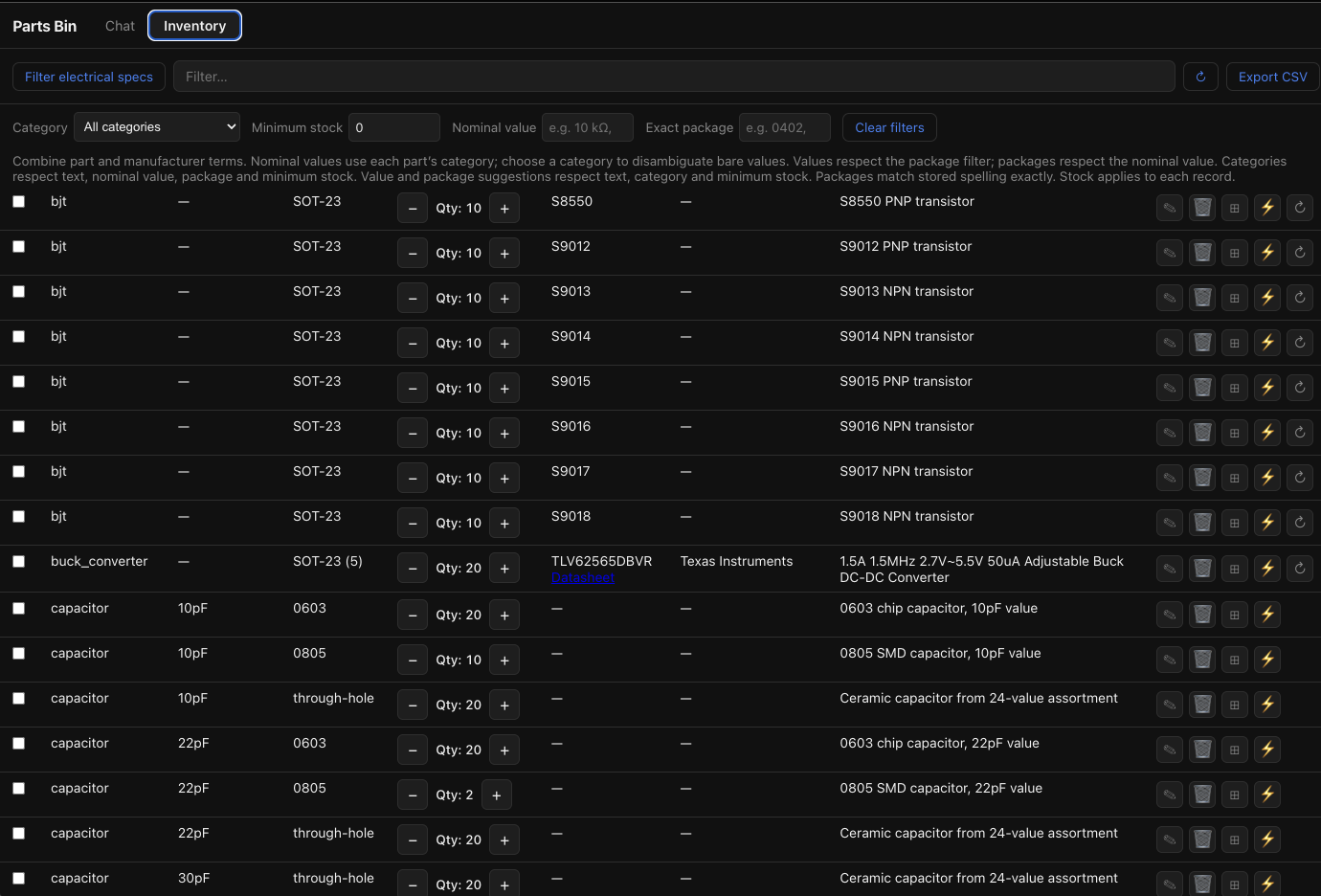
My Parts Bin inventory lists the transistors, capacitors and other components in my drawers by value, package and quantity.
Parts Bin can now look across several categories in one search. That lets me check the circuit’s shopping list together and see what I still need to find.
An assortment is where entering parts one at a time gets old. If I’m adding a whole strip of resistor values, I can tell Parts Bin the package size once and give it the list. It checks for duplicates across the batch. Later, when I paste in a parts list for a board, it can tell me the difference between “I need to buy these” and “I have these, but I’m three short.”